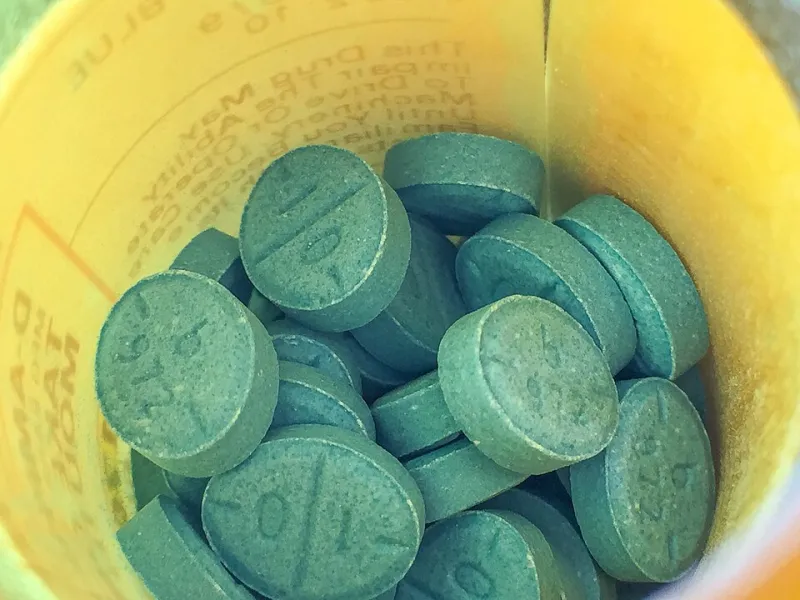
The Cabinet Pharmacy: Confronting Leftover Azithromycin and the Rise of Patient Self-Treatment
Photo: Matt Briney mbriney, CC0, via Wikimedia Commons
A Course Designed to Be Remembered — and Saved
Azithromycin is packaged for recall. Five doses, often on a single blister card, with the day printed on the foil. Patients recognize it, name it, and remember that it worked. The same design that makes adherence easy makes retention easy. When symptoms resolve on day three, the remaining doses go into a drawer, a purse, or a travel kit, where they wait for the next sore throat.
This is not a failure of patient character. It is a foreseeable consequence of how the drug is prescribed, packaged, and discussed. And it is one of the most overlooked pathways to inappropriate antibiotic use in the United States.
Why Azithromycin Specifically
Not every antibiotic becomes a household staple. Azithromycin has a set of features that make it unusually prone to hoarding:
- A short, memorable course that fits on one card
- Once-daily dosing that is easy to restart without instruction
- Rapid symptom relief, which reinforces the belief that the drug is uniquely powerful
- A reputation as a 'strong' antibiotic, often confused with broad-spectrum coverage
- Frequent prescribing for self-limited respiratory conditions in which symptoms improve before the course ends
- Automatic refills and 'just in case' prescriptions that create surplus supply
Few patients would save leftover insulin or anticoagulants. Many save leftover azithromycin without a second thought.
The Harms Are Not Hypothetical
Self-treatment with leftover azithromycin affects care in several directions at once.
It delays diagnosis. A patient who takes an old Z-Pack for a cough may postpone evaluation for pneumonia, pertussis, or a noninfectious cause. It masks symptoms without resolving the underlying process.
It distorts surveillance. Resistance data depend on knowing what was prescribed and when. Community use of leftover antibiotics is largely invisible to both prescribing records and public health reporting.
It applies selection pressure. Macrolide resistance in Streptococcus pneumoniae is already high in many US regions, and group A streptococcal resistance, while lower, is rising. Every unnecessary course contributes.
It creates avoidable harm. Leftover azithromycin can interact with QT-prolonging medications, trigger Clostridioides difficile infection, or contribute to the ototoxicity described elsewhere in this publication.
It invites dosing errors. Leftover pediatric suspensions are particularly hazardous because concentration and weight-based dosing are easily misremembered.
The Prescriber Controls the Supply
Leftover antibiotics are not created in the home. They are created at the point of prescribing. Several habits reduce surplus without compromising care.
Prescribe the exact quantity. A five-day course should not generate a ten-day bottle. For liquid formulations, dispense only what the course requires. Avoid automatic refills and 'just in case' prescriptions for travel or anticipated illness.
Say the number out loud. 'This is five doses. There should be nothing left when you finish.' Patients remember concrete instructions far better than a general reminder to finish the bottle.
Address the request directly. When a patient asks for a refill before a trip or a busy week, acknowledge the concern and explain why a standby antibiotic is a poor substitute for evaluation.
For patients on long-term azithromycin for COPD, cystic fibrosis, or mycobacterial disease, discuss secure storage and the importance of not sharing medication with household members.
Counseling Scripts
- 'You will take all five doses. When you finish, the pack should be empty. If you miss a dose, call us rather than borrowing from an old prescription.'
- 'If your symptoms come back, do not use an antibiotic you have at home. Call us. The right choice depends on what is happening now, not what happened last winter.'
- 'Please bring all your medicines to your next visit, including anything left over. We would rather review them than have you guess.'
- 'Antibiotics are not like pain relievers. Saving part of a course does not give you a head start next time; it gives you a dose that may be wrong, expired, or unnecessary.'
Disposal Without Improvisation
The Food and Drug Administration recommends drug take-back locations as the preferred route for most unused medicines. When a take-back site is not readily available, many antibiotics can be placed in a sealed bag mixed with coffee grounds or cat litter and discarded in household trash, provided the label does not instruct flushing. Patients should not flush azithromycin unless specifically directed, and they should not save partial courses for future use.
A brief disposal instruction at the end of a visit normalizes the behavior: 'If anything is left over, here is how to get rid of it safely.'
A Stewardship Metric Worth Tracking
Health systems track days of therapy and Clostridioides difficile rates, but few measure leftover supply. A simple follow-up question — 'Do you have any antibiotic left at home?' — can be incorporated into medication reconciliation and clinic surveys. Pharmacies can be engaged to accept returns where regulations permit. Prescribing dashboards can flag quantities that exceed course length.
The Stewardship Case
Antibiotic stewardship has spent years refining when to prescribe. It has spent far less time considering what happens after the bottle leaves the pharmacy. Leftover azithromycin is a predictable artifact of convenient packaging and incomplete counseling, and it converts a one-time prescription into an open-ended supply. Closing that loop is not an administrative nicety. It is a core part of keeping the drug useful.